



















Youth Conservation Leaders
A connected community of young people building Science leadership skills and networks to take action for wildlife.
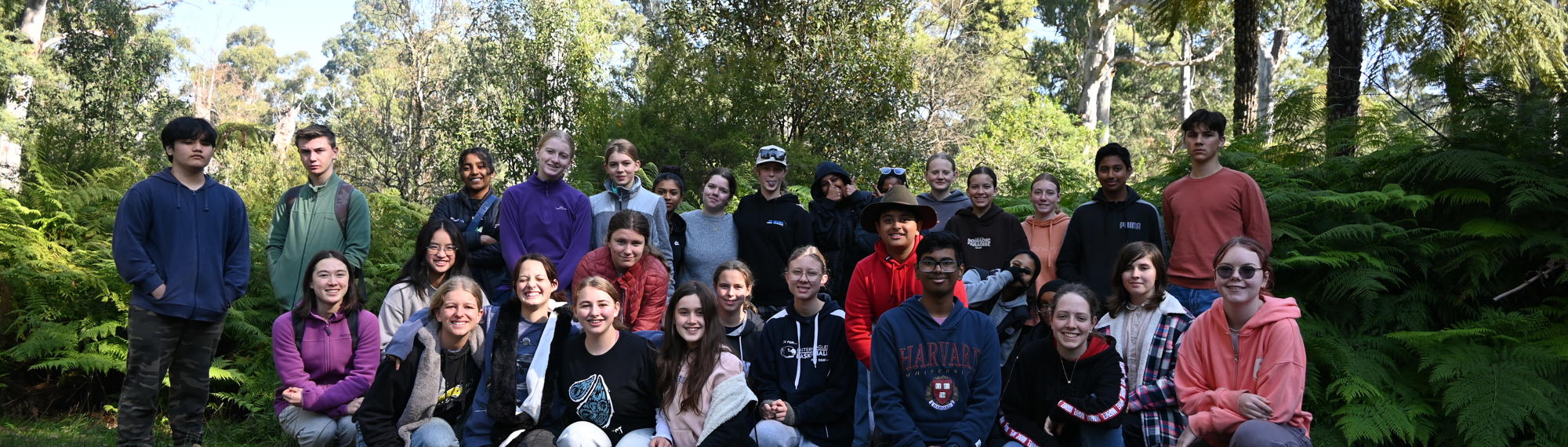
Year 9-10 Science students from across the state are invited to join Zoos Victoria’s Youth Conservation Leaders program. They will develop tangible and usable Science skills while growing as a leader in a group environment.
Students will learn from Zoos Victoria mentors and be supported to undertake a Science research project to inform a wildlife conservation project. Along the way, they will learn about First Peoples connections to the land and how to care for wildlife to ensure a sustainable future.
The program runs for 11 days from April to June 2026 during the school term.
Application timelines
Applications for the 2026 program are now closed.
Applications for the 2027 program will open in February 2027.
To be the first to hear when applications open and get the latest updates on other programs, youth initiatives, events, opportunities, and more, sign up to the youth newsletter.
Who this program is for
- Emerging science leaders - students who have drive and leadership potential to step up and take the lead in Science.
- Existing student leaders - students who are already in leadership positions and want to improve their Science skills and impact.
- Wildlife conservation champions - students who are passionate about wildlife and want to develop Science leadership skills for conservation projects.
What students will learn
Students will gain a deep understanding of their capabilities as Science leaders, tap into a sense of purpose and develop knowledge and skills that they will use beyond the program:
- Leadership skills
- Science knowledge and skills
- Communication skills
- Animal and wildlife conservation experience
- Mentoring and positive role models
- Project work to solve a real-world problem
Teacher involvement
Students need to be endorsed by a teacher at their school. This teacher plays a crucial role in supporting their student's development by regularly checking in, facilitating their student's attendance at the program, assisting with project work, and providing opportunities for students to develop their leadership skills.
Supporting teachers will need to be available to attend and participate in two days of the program.
|
Tuesday 28 April 2026 (school term) afternoon |
Online |
|
Wednesday 10 June 2026 (school term) lunch - Graduation |
Melbourne Zoo |
Inclusions
The cost of the program is $1,800 and includes:
- All workshops
- All food
- Leadership mentoring
- Behind the scenes experiences
- Access to industry experts
- Excursions including transport from Melbourne Zoo
- Accommodation for 4 overnight stays at Polana Camp
- Program materials
Scholarship positions are available for a limited number of students from low SES schools. Applications for these positions will be assessed on if the school Index of Community Socio-Educational Advantage (ICSEA) rating is 1000 or lower, teacher nomination, and the quality of the overall student application.
If needed, check your school ICSEA rating here.
Refer to the Terms and Conditions for the cancellation policy.
Program sequence
This program is running during the school term and is hosted at Melbourne Zoo and Healesville Sanctuary. All excursions to Healesville Sanctuary and surrounds will leave from Melbourne Zoo and include overnight stays
Here are the 2026 dates for your calendar*:
|
Thursday 30 April 2026 |
Melbourne Zoo |
|
Friday 1 May 2026 |
Melbourne Zoo |
|
Monday 4 May 2026 |
Healesville Sanctuary (including overnight stay in Healesville) |
|
Tuesday 5 May 2026 |
Haining Farm, Buxton spotlighting (including overnight stay in Healesville) |
|
Wednesday 6 May 2026 |
Healesville Sanctuary |
|
Wednesday 27 May 2026 |
Healesville Sanctuary (including overnight stay in Healesville) |
|
Thursday 28 May 2026 |
Yellingbo Nature Conservation Reserve (including overnight stay in Healesville) |
|
Friday 29 May 2026 |
Healesville Sanctuary |
|
Monday 1 June 2026 |
Melbourne Zoo, Parliament of Victoria |
|
Tuesday 2 June 2026 |
Melbourne Zoo |
|
Wednesday 10 June 2026 - Graduation |
Melbourne Zoo |
*There are no makeup sessions, refunds or discounts offered in the case of student absence. Refer to the Terms and Conditions for the cancellation policy.
Learning outcomes
Victorian Curriculum Year 9-10 Version 2.0
- Scientific knowledge is contestable and is validated and refined over time through expanding scientific methods, replication, publication, peer review and consensus (VC2S10H01)
- Advances in technologies have enabled advances in science, while science has contributed to developments in technologies and engineering (VC2S10H02)
- The use of scientific knowledge to address socio-scientific issues and shape a more sustainable future for humans and the environment may have diverse projected outcomes that affect the extent to which scientific knowledge and practices are adopted more broadly by society (VC2S10H03)
- Scientific knowledge may be interpreted in different ways by individuals and groups in society; the values and needs of society can influence the focus of scientific research (VC2S10H04)
- Investigable questions, reasoned predictions and hypotheses can be used in guiding investigations to test and develop explanatory models and relationships (VC2S10I01)
- Valid, reproducible investigations to answer questions and test hypotheses can be planned and conducted, including identifying and controlling for possible sources of error and bias in sampling or in making observations; safe, ethical investigations include undertaking risk assessments and following protocols when accessing cultural sites and artefacts on Country and Place (VC2S10I02)
- Equipment can be selected and used to generate and record data sets that show precision, including consideration of sample size and using digital tools as appropriate (VC2S10I03)
- Data and information can be organised, processed and summarised by selecting and constructing representations including tables, graphs, descriptive statistics, models, symbols, formulas and mathematical relationships (VC2S10I04)
- Information and processed data can be analysed and compared to identify and explain qualitative and quantitative patterns, trends, relationships and anomalies (VC2S10I05)
- Critical and Creative Thinking
- Ethical
- Intercultural
- Personal and Social